
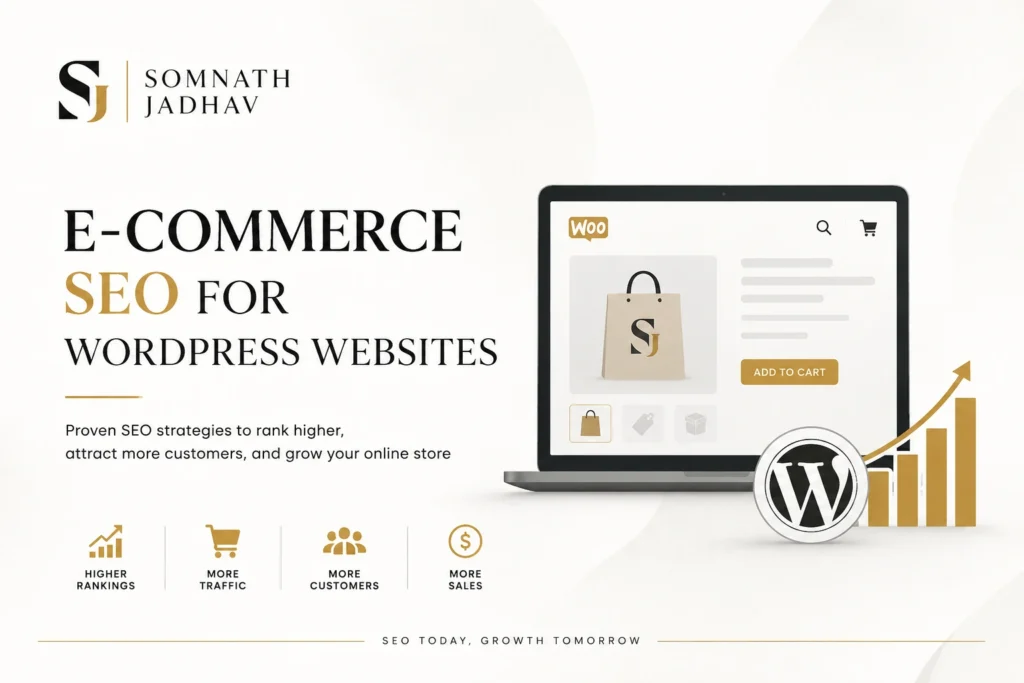
E-Commerce SEO for WordPress websites is essential for improving search visibility, attracting qualified traffic, and increasing online sales. By implementing the right SEO strategies, you can help your store rank higher and convert more visitors into customers.
Launching an online store is easier than ever with WordPress and WooCommerce. However, building an attractive online store doesn’t automatically bring customers. Every day, thousands of businesses compete for visibility in Google Search, and only those with a strong SEO strategy consistently attract qualified buyers.
This is where E-Commerce SEO for WordPress websites becomes one of the most valuable long-term investments for your business.
Unlike paid advertising that stops delivering traffic the moment you stop spending, search engine optimization helps your WooCommerce store generate organic visitors month after month. Whether you sell a handful of products or manage a large online catalogue, effective SEO improves your visibility, builds credibility, and creates a sustainable source of sales.
In this guide, you’ll learn how to optimize your WordPress e-commerce website—from keyword research and product pages to technical SEO, website speed, structured data, and content strategy.
What Is E-Commerce SEO?
E-Commerce SEO is the process of optimizing an online store so that products, categories, and related content rank higher in search engines like Google.
Unlike traditional websites, an e-commerce website contains hundreds—or even thousands—of pages. Every product, category, brand page, filter, image, and customer review contributes to your website’s search visibility.
For example, imagine someone searches for:
- Wireless Bluetooth Mouse
- Buy Gaming Keyboard Online
- Best Office Chair for Home Office
If your product pages are properly optimized, Google can display them directly in search results, allowing potential customers to discover your store before they visit your competitors.
The ultimate goal of e-commerce SEO isn’t simply to increase traffic—it’s to attract visitors who are ready to purchase.
Why SEO Matters for WordPress E-Commerce Websites
Many businesses rely almost entirely on paid advertising to generate sales. While paid campaigns can deliver quick results, they often become expensive over time.
SEO works differently.
Every optimized product page becomes a long-term asset capable of attracting visitors without paying for every click.
When implemented correctly, SEO helps you:
- Increase qualified organic traffic
- Reduce customer acquisition costs
- Build trust with potential buyers
- Improve brand visibility
- Generate consistent long-term sales
Think of your website as a retail store.
Paid advertising is similar to renting a busy shop every month. SEO, on the other hand, is like purchasing prime commercial property. It requires more effort initially, but it continues generating value for years.
Why WordPress and WooCommerce Are Excellent for SEO
One reason WooCommerce has become the world’s most popular e-commerce platform is the level of SEO control it offers.
Unlike many hosted platforms, WordPress allows you to customize nearly every aspect of your website.
You can optimize:
- Page URLs
- Meta titles
- Meta descriptions
- Product descriptions
- Internal links
- XML sitemaps
- Schema markup
- Image optimization
- Website performance
Combined with quality SEO plugins, WooCommerce gives businesses everything they need to build a search-friendly online store.
Start With Keyword Research
Successful SEO begins long before writing product descriptions.
It starts with understanding what your customers are actually searching for.
For example, if you sell office furniture, consider these search queries:
| Search Query | Search Intent |
|---|---|
| Office Chair | General |
| Best Office Chair | Research |
| Buy Office Chair Online | Transactional |
| Ergonomic Office Chair Under ₹10000 | High Purchase Intent |
Notice how each search reflects a different stage of the buying journey.
Instead of targeting only broad keywords, include long-tail search phrases that indicate stronger purchase intent.
Useful keyword research tools include:
- Google Search Console
- Google Keyword Planner
- Google Autocomplete
- Ahrefs
- Semrush
- Ubersuggest
The more closely your product pages match user intent, the better your chances of ranking.
Build a Logical Website Structure
Search engines—and shoppers—prefer websites that are easy to navigate.
A clean website hierarchy helps search engines crawl your content efficiently while making it easier for customers to discover products.
A simple structure might look like this:
Home
→ Product Categories
→ Subcategories
→ Product Pages
→ Related Articles
Avoid burying important products several levels deep. Ideally, customers should be able to reach any product within a few clicks from your homepage.
A well-organized website also improves internal linking, distributes authority throughout your site, and enhances the overall user experience.
How to Optimize Product Pages
Your product pages are where rankings become revenue.
Each product should provide enough information to answer a customer’s questions before they even think of leaving your website.
Write Descriptive Product Titles
Compare these examples:
Poor
Wireless Mouse
Better
Wireless Bluetooth Mouse for Laptop, Mac & Windows
The second title provides more context for both search engines and users.
Create Unique Product Descriptions
One of the biggest SEO mistakes online stores make is copying descriptions from manufacturers.
If dozens of websites use identical content, Google has little reason to rank yours above the rest.
Instead, explain:
- Features
- Benefits
- Specifications
- Use cases
- Warranty information
- Frequently asked questions
Write naturally and focus on helping customers make informed purchasing decisions.
Optimize Product Images
Images often drive buying decisions.
Use descriptive filenames before uploading images.
Instead of:
IMG001.jpg
Use:
wireless-bluetooth-mouse-black.jpg
Don’t forget descriptive alt text that accurately explains the image while naturally incorporating relevant keywords.
Also compress images and serve them in modern formats like WebP to improve loading speed.
Encourage Customer Reviews
Reviews provide more than social proof.
Every new review adds fresh, user-generated content to your product pages.
This helps improve relevance while building trust with future buyers.
Responding to customer reviews also demonstrates that your business is active and engaged.
Don’t Ignore Category Pages
Many online stores spend all their effort optimizing products while neglecting category pages.
This is a missed opportunity.
Category pages often target broader keywords with higher search volume.
Instead of displaying only products, include:
- A short introduction
- Buying advice
- Frequently asked questions
- Links to related categories
- Helpful internal links
This transforms category pages into valuable landing pages instead of simple product listings.
Create Helpful Content Beyond Product Pages
Modern e-commerce SEO extends far beyond products.
Informational content helps attract visitors earlier in the buying journey.
Examples include:
- Buying guides
- Product comparisons
- Maintenance tips
- Industry trends
- Frequently asked questions
- Tutorials
For instance, if you sell coffee machines, publishing an article such as “How to Choose the Right Espresso Machine for Home” can attract users before they’ve decided which brand to purchase.
These visitors can later be guided toward your products through strategic internal links.
Strengthen Your Internal Linking Strategy
Internal links help both search engines and users discover additional content.
Whenever appropriate, connect related pages naturally.
For example:
A buying guide can link to product categories.
A product page can link to maintenance articles.
A category page can recommend featured products.
This creates a stronger content ecosystem and improves crawlability.
Technical SEO Still Matters
Even the best content struggles if technical SEO is ignored.
Regularly review important elements such as:
- XML sitemap
- HTTPS
- Canonical URLs
- Robots.txt
- Breadcrumb navigation
- Broken links
- Redirects
- Duplicate pages
Technical improvements may not always be visible to visitors, but they play a critical role in helping search engines understand your website.
Improve Website Speed
Website speed directly influences both user experience and conversions.
Visitors expect pages to load almost instantly.
A slow online store leads to abandoned carts, lower engagement, and missed sales opportunities.
You can improve performance by:
- Choosing reliable hosting
- Compressing images
- Enabling caching
- Using a CDN
- Minimizing unnecessary plugins
- Optimizing your database
- Using lightweight themes
Even small improvements in loading time can have a measurable impact on revenue.
Optimize for Mobile Users
Today, many customers browse and purchase products using smartphones.
Your WooCommerce website should provide a seamless mobile experience.
Ask yourself:
- Is navigation easy with one hand?
- Are buttons large enough to tap?
- Is checkout simple?
- Do pages load quickly on mobile networks?
A responsive website isn’t just good for SEO—it improves customer satisfaction and conversions.
Use Structured Data
Structured data helps search engines understand your content more effectively.
For e-commerce websites, product schema can communicate valuable information such as:
- Product name
- Brand
- Price
- Availability
- Ratings
- Reviews
- SKU
When implemented correctly, structured data may enhance your search listings with rich results that attract more attention and improve click-through rates.
Common WooCommerce SEO Mistakes
Many websites fail to rank because of avoidable issues rather than a lack of effort.
Some of the most common mistakes include:
- Duplicate product descriptions
- Missing image alt text
- Slow-loading pages
- Poor internal linking
- Thin category pages
- Broken links
- Missing schema markup
- Ignoring Google Search Console
- Publishing low-quality AI-generated content without review
Avoiding these mistakes often delivers faster improvements than constantly chasing new SEO tactics.
Frequently Asked Questions
Is WooCommerce SEO-friendly?
Yes. WooCommerce provides excellent SEO flexibility when combined with a fast WordPress setup, quality content, and proper optimization practices.
How long does e-commerce SEO take?
SEO is a long-term strategy. While minor improvements can appear within a few weeks, meaningful growth typically takes several months, depending on competition, website quality, and content consistency.
Should every product have a unique description?
Absolutely. Unique descriptions help search engines understand your products and reduce the risk of duplicate content issues.
Does blogging help an online store?
Yes. Informative articles allow you to target broader search queries, educate customers, and create natural pathways to your product pages.
Which is more important: technical SEO or content?
Both are essential. Technical SEO ensures search engines can crawl and understand your website, while high-quality content helps you earn rankings and satisfy user intent.
E-Commerce SEO Checklist
Before publishing or reviewing your online store, make sure you’ve covered these essentials:
| SEO Task | Completed |
|---|---|
| Keyword research completed | □ |
| Unique product titles | □ |
| Original product descriptions | □ |
| Optimized product images | □ |
| Category page content | □ |
| Internal linking | □ |
| Product schema | □ |
| Mobile-friendly design | □ |
| Fast loading speed | □ |
| XML sitemap submitted | □ |
| Google Search Console configured | □ |
Final Thoughts
Building a successful online store requires more than uploading products and hoping customers will find them. Search engines reward websites that provide value, answer customer questions, and deliver an excellent user experience.
By combining keyword research, well-optimized product pages, helpful informational content, strong technical SEO, and fast website performance, you create a WooCommerce store that attracts qualified visitors and converts them into loyal customers.
SEO is not a one-time project. It is an ongoing process of improving content, monitoring performance, refining your strategy, and adapting to changing search behavior. Businesses that consistently invest in e-commerce SEO are far better positioned to achieve sustainable growth than those relying solely on paid advertising.
If you’re planning to grow your online store, treat SEO as a core business investment rather than an optional marketing activity. Over time, the visibility, trust, and organic traffic you build can become one of your most valuable competitive advantages.