
Most business owners are proud of how hard they work.
They work longer hours than their employees.
They solve problems late into the night.
They answer customer calls on weekends.
They personally approve every payment, quotation, and important decision.
For many entrepreneurs, hard work becomes part of their identity.
And during the early stages of a business, that’s often necessary.
But there comes a point where hard work stops being an advantage.
Instead, it becomes the biggest obstacle to growth.
The businesses that survive and scale over decades aren’t necessarily run by the hardest-working people.
They’re run by people who build systems.
This article is part of our Business Fragility series. For the complete framework, read Hidden Business Risks: Why Most Businesses Are One Weak Link Away From Failure
Hard Work Solves Today’s Problems. Systems Prevent Tomorrow’s.
Imagine two manufacturing companies.
The first company constantly faces delayed orders.
Whenever a problem occurs, the owner personally steps in.
He calls suppliers.
He speaks with customers.
He rearranges production schedules.
Every problem gets solved.
But every solution depends on him.
The second company experiences similar issues initially.
Instead of solving the same problem repeatedly, they ask:
Why did this happen?
They discover that inventory updates are delayed.
So they redesign their inventory process.
They create standard operating procedures.
They automate notifications.
They define ownership.
The same problem never occurs again.
Both owners worked hard.
Only one improved the system.
Every Repeated Problem Is a System Problem
Businesses often mistake recurring issues as isolated incidents.
Late deliveries.
Customer complaints.
Missed follow-ups.
Incorrect invoices.
Employees making mistakes.
Production delays.
These appear to be different problems.
In reality, they’re often symptoms of one weak system.
If the same issue keeps happening, working harder isn’t the answer.
Improving the process is.
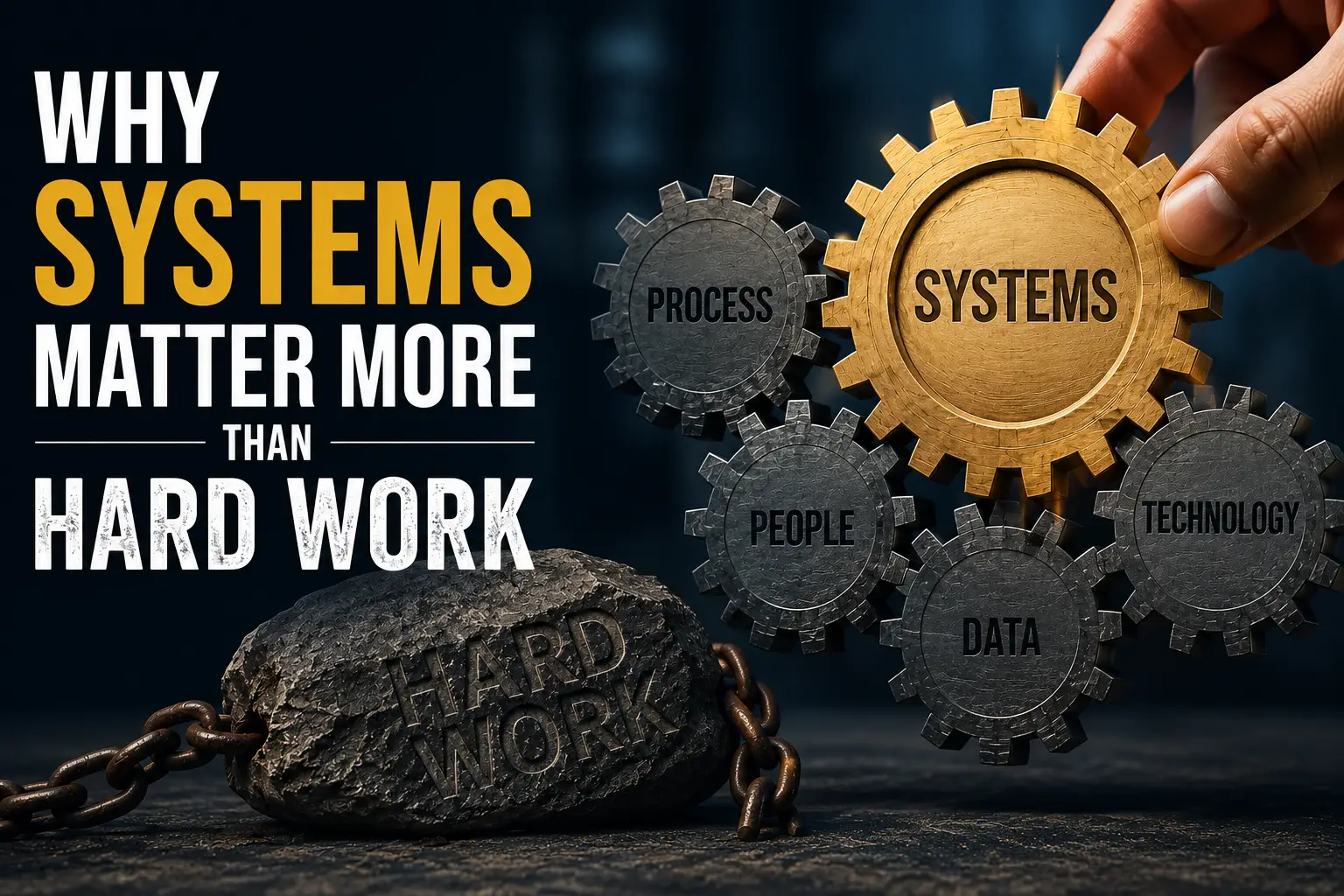
Why Hard Work Doesn’t Scale
Every business has limited human capacity.
An owner can only:
- Attend so many meetings.
- Approve so many decisions.
- Solve so many crises.
- Work so many hours.
Eventually, the business reaches a ceiling.
Growth slows.
Stress increases.
Customers experience inconsistency.
Employees become dependent on the owner.
The business becomes busy—but not better.
This is one of the clearest signs that the business lacks systems.
Systems Create Predictable Results
A good system doesn’t rely on memory.
It doesn’t depend on motivation.
It doesn’t require exceptional employees.
Instead, it creates consistency.
Think about commercial aviation.
Thousands of flights take off every day.
Not because every pilot is perfect.
But because aviation relies on checklists, procedures, training, and standard operating systems.
Business works the same way.
Reliable systems reduce human error.
The Four Systems Every Business Needs
Every growing business should build systems in four critical areas.
1. Sales System
A repeatable process for generating enquiries, qualifying prospects, following up, and converting customers.
Without one, sales depend on luck.
2. Operations System
How work moves from order to delivery.
Clear responsibilities.
Defined workflows.
Quality checkpoints.
Documentation.
3. Financial System
Cash flow monitoring.
Expense approvals.
Profit tracking.
Collections.
Budgeting.
Money problems rarely begin in accounting.
They begin with weak financial systems.
4. Decision-Making System
Who approves what?
When should issues be escalated?
What metrics determine success?
Businesses become faster when decisions are systematic rather than personal.
Systems Reduce Risk
Most business owners think systems improve efficiency.
They do.
But that’s only half the story.
Systems primarily reduce risk.
Without systems:
- One employee leaving creates chaos.
- One supplier failure stops production.
- One missed payment creates cash flow issues.
- One forgotten task disappoints customers.
Systems make businesses more resilient.
Systems Free the Owner
Many founders unknowingly become the operating system of their own company.
Nothing moves without them.
This creates hidden fragility.
The goal of business isn’t to become indispensable.
The goal is to build a business that continues performing even when you’re unavailable.
That’s true leverage.
Building Systems Doesn’t Mean Creating Bureaucracy
Some owners avoid systems because they imagine endless documentation and complicated procedures.
That’s not what good systems look like.
A good system should make work easier, not harder.
Start small.
Document one recurring task.
Create one checklist.
Automate one repetitive process.
Assign clear ownership.
Improve one bottleneck every month.
Over time, these small improvements compound into a business that is more reliable, efficient, and scalable.
From Effort to Leverage
There’s nothing wrong with hard work.
In fact, every successful business is built on it.
But businesses don’t scale because owners work longer hours.
They scale because owners create processes that deliver consistent results without requiring constant intervention.
Hard work builds momentum.
Systems preserve it.
One creates progress.
The other creates permanence.
Ask Yourself
Consider these questions:
- If you took a two-week vacation tomorrow, what would stop working?
- Which tasks only you can perform?
- Which problems keep returning every month?
- Where does your team rely on memory instead of documented processes?
- What is one repetitive activity you could systemize this week?
The answers reveal where your business depends on effort instead of systems.
Final Thoughts
Hard work is essential, especially in the early stages of building a business. But lasting success comes from replacing repeated effort with repeatable systems.
Every recurring problem is an opportunity to improve how your business operates. Every documented process reduces dependency on individuals. Every well-designed system makes your business more resilient, more efficient, and easier to scale.
The strongest businesses aren’t built on heroic founders who solve every problem themselves.
They’re built on systems that keep delivering results—even when the founder isn’t in the room.