
Every business has hidden business risks that often go unnoticed until they cause serious problems. Understanding these hidden business risks is the first step toward building a resilient business. They often remain invisible until a supplier fails, a key employee leaves, cash flow tightens, or technology breaks down. This article explains the concept of Business Fragility—a practical framework for identifying the weak links that quietly threaten growth. Learn how to uncover these risks, improve business resilience, and build systems that continue performing even during uncertainty.
Imagine two businesses operating in the same industry.
Both have been profitable for years. Both have loyal customers. Both employ talented people. Both appear successful from the outside.
Then an unexpected event occurs.
A key employee resigns.
A supplier suddenly stops delivering.
A cyberattack shuts down critical systems.
Or the founder becomes unavailable for a month due to illness.
One business experiences disruption, adapts quickly, and continues operating.
The other struggles to recover. Projects are delayed, customers become frustrated, cash flow deteriorates, employees become overwhelmed, and months of progress begin to unravel.
The difference wasn’t the event itself.
The difference was how prepared each business was before the event occurred.
This is one of the most overlooked realities of running a business: most companies don’t fail because of one catastrophic mistake. They fail because an ordinary event exposes a hidden weakness that has existed for years.
These hidden weaknesses often remain invisible during periods of stability. Revenue continues to grow, customers remain satisfied, and daily operations create the comforting illusion that everything is under control.
But success has a way of hiding risk.
As long as conditions remain favourable, fragile systems often appear just as capable as resilient ones. The real test comes when something unexpected happens.
And something unexpected always happens.
Markets change.
Technology evolves.
Customers’ expectations shift.
Competitors emerge.
Economic conditions fluctuate.
People leave.
Systems fail.
The question is never whether your business will face disruption. The question is how your business will respond when it does.
The businesses that survive uncertainty aren’t necessarily the biggest, oldest, or most profitable. They are the ones that have deliberately reduced their dependence on single points of failure and built systems that can withstand unexpected shocks.
In other words, they have focused not only on growth—but also on resilience.
This article explores the concept of business fragility: what it is, why it matters, how it quietly develops, and why many successful businesses don’t recognize it until it’s too late.
More importantly, you’ll learn how to identify hidden weak links within your own business and begin strengthening them before circumstances force you to.
Because the goal of a great business isn’t simply to grow.
It’s to keep growing—even when conditions become difficult.
Business continuity is a critical part of reducing hidden business risks.
What Are Hidden Business Risks?
Most business owners naturally focus on visible metrics.
Revenue.
Profit.
Number of customers.
Sales targets.
Website traffic.
Employee count.
While these numbers are important, they don’t always reveal the true health of a business.
A company can be profitable and still be fragile.
It can be growing rapidly while becoming increasingly vulnerable.
It can look successful from the outside while relying on a handful of hidden assumptions that could collapse without warning.
Business fragility is the degree to which a business is vulnerable to disruption because it depends too heavily on people, systems, customers, suppliers, technology, or decisions that lack resilience.
Simply put:
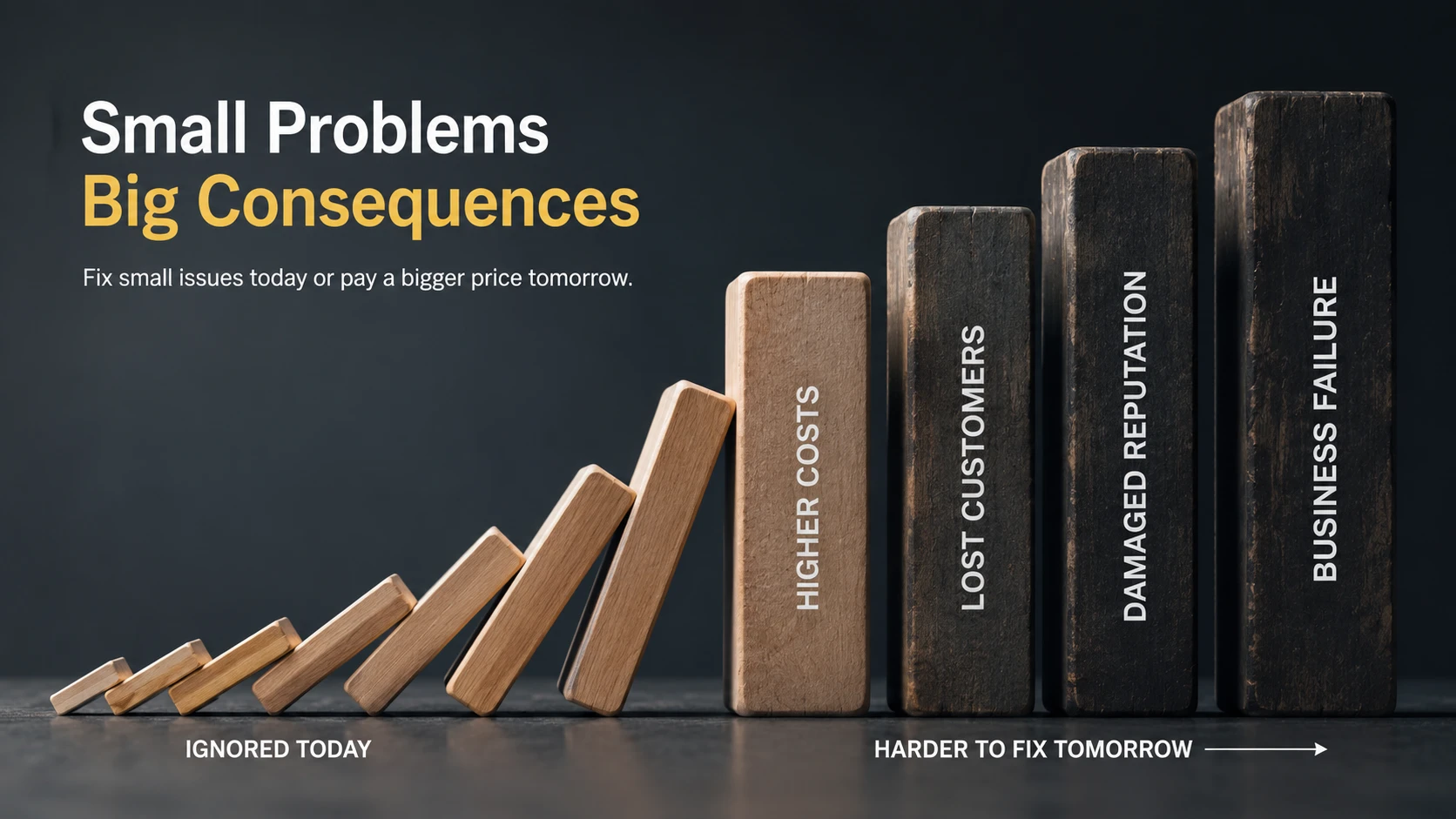
A fragile business is one where a relatively small problem creates disproportionately large consequences.
Think about a chain.
A chain doesn’t fail because every link is weak.
It fails because one link is weaker than the others.
Businesses operate in much the same way.
A company may have excellent products, talented employees, healthy profits, and strong customer relationships.
Yet if one critical dependency fails, the entire business can suffer.
That dependency might be:
- One major customer generating half the company’s revenue.
- A founder who approves every important decision.
- A single supplier providing essential raw materials.
- An outdated software system with no backup.
- One salesperson who holds every client relationship.
None of these seem like immediate problems while everything is functioning normally.
In fact, many business owners view them as signs of efficiency.
“We’ve worked with this supplier for fifteen years.”
“Our operations manager knows everything.”
“Our largest customer has always been loyal.”
“I’m involved in every important decision because that’s how we maintain quality.”
These statements often sound reassuring.
But they may also reveal hidden concentration of risk.
Business fragility isn’t about making mistakes.
It’s about creating situations where too much depends on too little.
The purpose of the Business Fragility Framework is to help organizations identify hidden business risks before they become expensive failures.
Why Hidden Business Risks Are Really About Dependency
Every business depends on something.
Customers.
Employees.
Cash flow.
Technology.
Supply chains.
The problem isn’t dependency itself.
The problem is over-dependency.
When a business becomes heavily reliant on a single resource without viable alternatives, it creates a single point of failure.
This is similar to standing on one leg.
As long as nothing disturbs your balance, everything seems fine.
But the moment you’re pushed unexpectedly, staying upright becomes much harder.
A business diversified across multiple customers, documented processes, trained teams, reliable technology, and healthy cash reserves has many ways to absorb shocks.
A fragile business has very few.
Strong Businesses Don’t Eliminate Risk
Many people assume resilient businesses avoid risk.
They don’t.
Every business involves uncertainty.
Launching new products carries risk.
Hiring employees carries risk.
Entering new markets carries risk.
Investing in technology carries risk.
Risk cannot be eliminated.
It can only be understood, managed, and reduced.
The strongest businesses don’t spend their energy trying to predict every possible crisis.
Instead, they build systems capable of adapting regardless of what happens.
That’s a fundamentally different mindset.
Rather than asking,
“How can we avoid problems?”
They ask,
“How can we continue operating when problems inevitably occur?”
This subtle shift changes how leaders make decisions.
Hidden Business Risks Often Hide Behind Efficiency
Ironically, many fragile businesses don’t become fragile because of poor management.
They become fragile because they optimise for efficiency without considering resilience.
Consider a manufacturer that purchases all its materials from one supplier because they consistently offer the lowest prices.
On paper, this seems like a smart financial decision.
Until that supplier experiences a strike, natural disaster, bankruptcy, or logistical disruption.
Suddenly production stops.
Customers wait.
Revenue declines.
An effort to improve efficiency unintentionally increased risk.
The same pattern appears across businesses of every size.
A founder handles every client meeting because customers prefer speaking directly with them.
An accountant becomes the only person who understands financial systems.
A sales executive develops exclusive relationships with major customers.
A developer becomes the only employee capable of maintaining the company’s software.
Each decision makes sense individually.
Over time, however, they create invisible bottlenecks.
Efficiency increases.
Flexibility decreases.
Eventually, one absence or disruption affects the entire business.
Why Can Success Hide Business Risks?
One of the greatest dangers in business is believing that today’s success proves tomorrow’s security.
It doesn’t.
In fact, success can be surprisingly deceptive.
When revenue is increasing and customers are satisfied, businesses naturally become more confident.
Problems feel smaller.
Warning signs are easier to ignore.
Difficult questions get postponed because there are more urgent opportunities to pursue.
After all, why fix something that appears to be working?
The challenge is that good outcomes don’t always come from strong systems.
Sometimes they come from favourable conditions.
A growing market.
Strong demand.
Loyal customers.
Exceptional employees.
A founder working extraordinary hours.
All of these can mask underlying weaknesses.
Growth Doesn’t Always Mean Strength
Imagine two companies each growing at 25% per year.
From the outside, they look almost identical.
But internally, they operate very differently.
The first business has documented processes, distributed responsibilities, diversified customers, multiple suppliers, healthy cash reserves, and technology that supports operations.
The second business depends on one founder making every important decision, one salesperson generating most revenue, one supplier, and undocumented workflows known only by experienced employees.
Today, both businesses appear equally successful.
Next year, they may look completely different.
Growth tells us what is happening.
It doesn’t tell us how sustainable it is.
Revenue Is Not the Same as Resilience
Business owners often use revenue as the primary indicator of success.
Revenue matters.
But revenue alone doesn’t answer questions like:
- How quickly can your business recover from disruption?
- Can operations continue without the founder?
- How long could the business survive if sales declined?
- What happens if your largest customer leaves?
- Can new employees perform consistently using documented systems?
These questions reveal something revenue cannot.
They reveal resilience.
Two companies earning ₹10 crore annually may have dramatically different levels of resilience.
One could survive months of disruption.
The other might struggle after losing a single customer.
The difference isn’t visible in the income statement.
It’s hidden inside the way the business is built.
The Comfort of Routine
Perhaps the greatest reason fragility goes unnoticed is that daily operations create a sense of normality.
Employees come to work.
Orders are fulfilled.
Meetings happen.
Customers pay invoices.
Business owners become accustomed to routine.
After months—or even years—of smooth operations, assumptions become accepted as facts.
“Our systems are reliable.”
“Our customers will stay.”
“Our key employee isn’t going anywhere.”
“Our supplier has never let us down.”
These statements aren’t necessarily wrong.
They’re simply untested.
And assumptions that remain untested for long enough often become invisible risks.
History repeatedly shows that businesses rarely collapse because they expected disruption.
They struggle because they assumed stability would continue indefinitely.
Success Should Increase Curiosity, Not Complacency
Paradoxically, the best time to examine business fragility isn’t during a crisis.
It’s during success.
When the business is profitable, leaders have the resources, time, and flexibility to strengthen weak systems before they’re tested.
Unfortunately, success often encourages the opposite behaviour.
Instead of asking,
“Where are we vulnerable?”
leaders begin asking,
“How can we grow even faster?”
Growth is important.
But growth built on fragile foundations simply increases the consequences of failure.
Building a larger business without strengthening its underlying systems is like constructing additional floors on a building without reinforcing its structure.
It may stand for years.
Until one unexpected event reveals what was always there.
Common Hidden Business Risks That Make Businesses Fragile
Business fragility rarely appears overnight.
It develops gradually through a series of small decisions that seem reasonable at the time.
Hiring one more person instead of documenting a process.
Keeping the founder involved in every important decision.
Relying on a trusted supplier because “they’ve never let us down.”
Accepting that one customer accounts for nearly half of the company’s revenue because “they’ve always been loyal.”
None of these decisions look dangerous individually.
In fact, many of them contribute to short-term growth and efficiency.
The problem is that every dependency increases the impact of an unexpected event.
The more your business relies on a single person, customer, supplier, technology, or process, the more fragile it becomes.
Let’s examine the most common weak links hidden inside growing businesses.
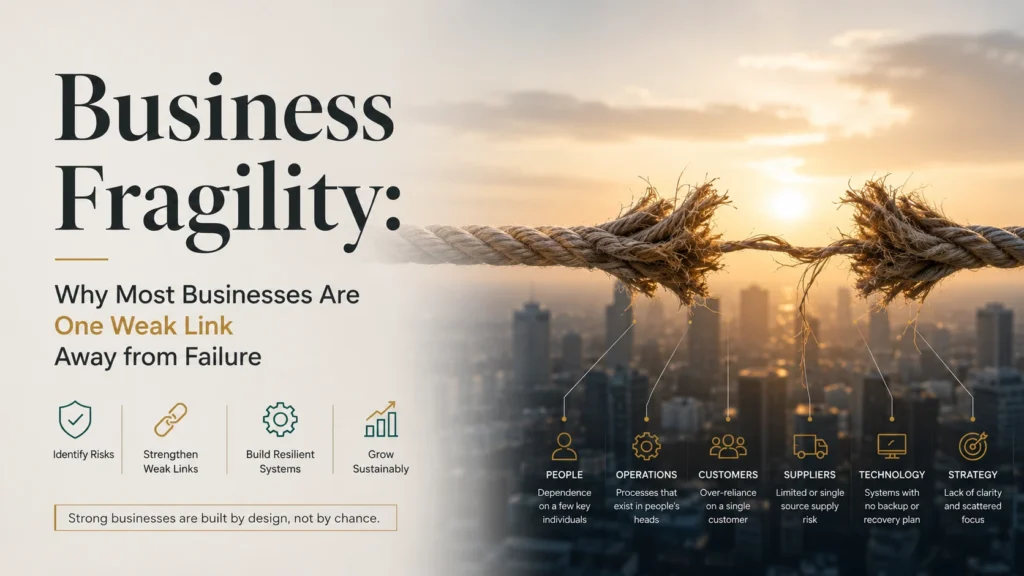
Most companies face multiple hidden business risks, including financial, operational, technological, and strategic vulnerabilities.
Financial Fragility
Every business needs cash to survive.
Yet many profitable businesses operate with surprisingly little financial resilience.
Revenue may be growing, but cash reserves remain thin. Payments from customers are delayed, while salaries, rent, and supplier bills continue to arrive on time.
This creates a dangerous situation where the business appears healthy but has very little room for error.
Imagine a manufacturing company that generates ₹10 crore annually.
On paper, it looks successful.
But if most customers pay after 90 days while suppliers demand payment within 30 days, the company constantly struggles with working capital.
Now imagine one major customer delays payment by another month.
Nothing else has changed.
The company is still profitable.
Yet it suddenly struggles to pay employees and suppliers.
The business didn’t become unprofitable overnight.
It became vulnerable because it lacked financial resilience.
Common signs of financial fragility
- Little or no cash reserve
- Heavy dependence on overdrafts or short-term borrowing
- Poor cash flow despite strong sales
- High customer payment delays
- Excessive debt obligations
- Thin operating margins
Ask yourself
If sales stopped for the next three months, how long could your business continue operating?
If the answer makes you uncomfortable, financial resilience deserves immediate attention.
Cash flow problems are among the most common hidden business risks affecting growing businesses.
Operational Hidden Business Risks That Slow Business Growth
Many businesses don’t have an operations one problem away from serious trouble.
They have a documentation problem.
Critical processes exist only inside people’s heads.
The founder knows how quotations are prepared.
An experienced employee knows how production schedules are managed.
The accounts manager understands every GST filing requirement.
Everything functions smoothly—until one of those people is unavailable.
Without documented systems, businesses become increasingly dependent on individual memory instead of organizational capability.
As businesses grow, this dependency becomes harder to manage.
Every new employee requires more training.
Every absence creates uncertainty.
Poor documentation and inconsistent processes create hidden business risks that limit scalability.
Every mistake becomes more expensive.
Well-designed systems don’t eliminate human expertise.
They make expertise repeatable.
Signs of operational fragility
- Processes exist only verbally.
- Different employees perform the same task differently.
- Every decision requires founder approval.
- Training new employees takes months.
- Work quality depends on who performs it.
The goal isn’t bureaucracy.
It’s consistency.
Customer Fragility
One customer can help a business grow.
One customer should never determine whether a business survives.
Overdependence on a few customers is one of the most dangerous hidden business risks.
Many companies proudly say,
“Our biggest client contributes 60% of our revenue.”
While that customer relationship may be valuable, it also creates enormous risk.
If that customer changes strategy, negotiates aggressively, delays payments, moves production overseas, or selects another supplier, the consequences extend far beyond lost revenue.
Hiring plans stop.
Investments are postponed.
Cash flow deteriorates.
Employees become uncertain.
The business suddenly shifts from growth mode to survival mode.
This isn’t a customer problem.
It’s a dependency problem.
Warning signs
- One customer contributes more than 30–40% of revenue.
- A single industry dominates your client base.
- Most enquiries come from one marketing channel.
- Losing one customer would require layoffs.
Diversification doesn’t mean serving everyone.
It means avoiding dependence on anyone.
Supplier Fragility
Supplier dependency creates hidden business risks that can disrupt production and customer delivery.
Supply chains often receive attention only after they fail.
Many businesses rely on a single supplier because they offer competitive pricing, consistent quality, or a long-standing relationship.
Those are good reasons to build partnerships.
They’re not good reasons to eliminate alternatives.
Recent years have demonstrated how quickly supply chains can be disrupted.
Factories shut down.
Shipping costs increased dramatically.
Ports became congested.
Political tensions affected imports.
Natural disasters interrupted production.
Businesses with multiple sourcing options adapted more quickly.
Businesses dependent on one supplier often had no immediate solution.
Global organizations recommend building more resilient supply chains.
Ask yourself
- What happens if your primary supplier closes for one month?
- How long would production continue?
- Do you know who your alternative suppliers are?
- Have you ever tested them?
The best backup supplier is identified before you need one.
Technology Fragility
Technology now supports almost every part of business.
Sales.
Communication.
Finance.
Inventory.
Customer service.
Marketing.
Production planning.
Yet many businesses still treat technology as something that simply needs to “keep working.”
Until it doesn’t.
A server fails.
A ransomware attack encrypts company data.
The website crashes during peak sales.
Critical files are accidentally deleted.
Outdated software, weak cybersecurity, and manual workflows are significant hidden business risks for modern businesses.
Backups don’t exist—or haven’t been tested.
The issue isn’t the technology itself.
The issue is assuming technology will always be available.
Following recognized cybersecurity standards helps reduce technology-related business risks.
Technology risks include
- No reliable backups
- Weak cybersecurity
- Outdated software
- Single administrator access
- Poor password management
- No disaster recovery plan
Technology should increase resilience, not create additional dependency.
People Fragility
Every business depends on talented people.
The danger arises when knowledge becomes concentrated in just one person.
Perhaps it’s the production manager who understands every machine.
The salesperson who personally manages every important customer.
The developer who built the company’s software.
Or the founder who makes every strategic decision.
Founder dependency and key-person reliance are often overlooked hidden business risks.
These individuals are valuable.
But when essential knowledge exists only in one person’s mind, the business becomes fragile.
If they resign, retire, become ill, or simply take a long vacation, operations begin slowing almost immediately.
The business hasn’t lost capability.
It has lost access to capability.
Healthy businesses distribute knowledge.
They document processes.
Cross-train employees.
Encourage collaboration.
Reduce dependence on individual heroes.
Because resilience isn’t about having indispensable people.
It’s about ensuring the business remains dependable even when indispensable people are unavailable.
Reputation Fragility
Trust takes years to build.
It can disappear surprisingly quickly.
Today’s customers research businesses before making purchasing decisions.
They read reviews.
Visit websites.
Compare competitors.
Check LinkedIn profiles.
Look for case studies.
Search social media.
A single negative incident may not destroy a strong reputation.
But businesses that neglect customer experience, communication, or quality often discover that reputation is much more fragile than they expected.
Digital reputation has become a business asset.
Like any asset, it requires continuous attention.
Strategic Fragility
Perhaps the most dangerous form of fragility isn’t operational.
It’s strategic.
A business without strategic clarity often appears busy.
It launches new services.
Targets different industries.
Experiments with new pricing.
Changes marketing messages frequently.
Pursues every opportunity.
From the outside, this looks like growth.
Internally, it creates confusion.
Employees don’t understand priorities.
Customers don’t understand positioning.
Resources become scattered.
Decision-making slows.
Instead of strengthening the business, constant reaction gradually weakens it.
Strong businesses don’t say yes to every opportunity.
They deliberately choose what not to pursue.
Focus is a form of resilience.
Real-World Examples of Business Fragility
Business fragility isn’t a theoretical concept.
History repeatedly demonstrates how hidden weaknesses become visible only during periods of disruption.
The event attracts attention.
The underlying weakness is what actually causes lasting damage.
Here are a few examples.
COVID-19 Didn’t Create Every Problem
When COVID-19 disrupted economies worldwide, many businesses experienced severe difficulties.
It would be easy to conclude that the pandemic caused those failures.
In reality, the pandemic often exposed weaknesses that already existed.
Restaurants dependent only on dine-in customers struggled far more than those that had already invested in takeaway, delivery, or digital ordering.
Professional service firms with cloud-based systems transitioned to remote work much faster than businesses dependent entirely on physical offices.
Manufacturers with diversified supplier networks recovered more quickly than those relying on a single overseas source.
The crisis didn’t create these differences.
It revealed them.
The Semiconductor Shortage
Modern vehicles contain hundreds of electronic components.
When global semiconductor shortages disrupted supply chains, many automobile manufacturers reduced production despite continued customer demand.
Their factories hadn’t become less capable.
Their dependency had become visible.
One missing component prevented the production of an entire vehicle.
A tiny weakness created enormous consequences.
Founder Dependency
Consider two growing businesses.
In the first company, the founder approves every quotation, hires every employee, resolves every customer complaint, manages key relationships, and makes every important decision.
The business performs well.
Until the founder takes an unexpected month-long break.
Suddenly approvals stop.
Employees hesitate.
Customers wait.
Projects slow.
Growth pauses.
The founder wasn’t simply leading the business.
They had unknowingly become its operating system.
The Website That Stopped the Business
Imagine a B2B manufacturing company that receives most enquiries through its website.
One morning the website is hacked.
Forms stop working.
Search rankings disappear.
No recent backups exist.
The issue isn’t merely a technical failure.
Sales enquiries decline.
The sales pipeline weakens.
Marketing campaigns become ineffective.
Customer confidence drops.
A digital system that quietly supported growth has now become a single point of failure.
Technology problems often become business problems.
The Pattern Behind Every Example
Although these examples involve different industries and circumstances, they all share one common principle.
The triggering event wasn’t the true cause of the problem.
The real cause was an existing dependency that had gone unnoticed.
The pandemic wasn’t the weakness.
Customer concentration was.
The cyberattack wasn’t the weakness.
Poor digital resilience was.
The founder’s absence wasn’t the weakness.
Founder dependency was.
The supplier failure wasn’t the weakness.
Lack of alternatives was.
Events expose fragility. They rarely create it.
How to Identify Fragility in Your Business
By now, one thing should be clear:
Business fragility isn’t always visible.
It doesn’t appear on a profit and loss statement.
It isn’t revealed by revenue growth alone.
And it rarely announces itself before becoming a problem.
The only reliable way to reduce fragility is to actively look for it.
Many business owners spend years improving sales, marketing, operations, and customer service. Few spend time asking a much simpler question:
“What could stop this business from operating tomorrow?”
The answer to that question often reveals your biggest risks.
Fortunately, identifying fragility doesn’t require expensive consultants or complex software. It starts with developing a habit of questioning assumptions.

A Simple Five-Step Business Fragility Assessment
Think of this as a health check for your business.
The goal isn’t to predict every possible crisis.
The goal is to identify where your business is overly dependent on a single person, process, system, or resource.
Use this checklist to uncover hidden business risks that may already exist in your organization.
Step 1: List Your Critical Dependencies
Start by writing down everything your business depends on to operate successfully.
For example:
- Largest customers
- Key employees
- Suppliers
- Software systems
- Website
- Production equipment
- Founder
- Sales channels
- Banking relationships
- Cloud services
- Internet connectivity
- Logistics partners
Don’t overthink it.
Simply ask:
“What must continue working for our business to function normally?”
Step 2: Ask the “What If Tomorrow?” Question
Now imagine that each dependency disappears tomorrow.
Ask questions like:
- What if our biggest customer leaves?
- What if our production manager resigns?
- What if our ERP system stops working?
- What if our supplier closes unexpectedly?
- What if our website goes offline for two weeks?
- What if the founder becomes unavailable for a month?
This exercise often produces uncomfortable conversations.
That’s exactly why it’s valuable.
Step 3: Measure the Impact
For every dependency, estimate its impact.
| Dependency | Impact |
|---|---|
| Minor inconvenience | Low |
| Temporary disruption | Medium |
| Serious operational issues | High |
| Business cannot operate | Critical |
Don’t focus on probabilities.
Focus on consequences.
Some events are unlikely.
But if the consequences are catastrophic, they deserve attention.
Step 4: Estimate Recovery Time
Ask another question:
“If this happened tomorrow, how long would it take to recover?”
Recovery time often reveals risks that businesses underestimate.
| Dependency | Recovery Time |
|---|---|
| Lost customer | 6–12 months |
| Failed supplier | 2–8 weeks |
| Website hacked | Days or weeks |
| Founder unavailable | Immediate impact |
| Lost employee | 3–6 months |
The longer the recovery, the greater the fragility.
Step 5: Prioritize Your Weak Links
Not every risk deserves equal attention.
Focus first on dependencies that have:
- High impact
- Long recovery time
- High likelihood of occurring
These are your weakest links.
And strengthening even one of them can significantly improve your business’s resilience.
Principles for Building a More Resilient Business
Resilience isn’t created through one major decision.
It’s built through hundreds of small decisions that reduce dependency and increase adaptability.
Here are some timeless principles that apply to businesses of every size.
1. Build Systems Instead of Relying on Memory
Businesses shouldn’t depend on people remembering everything.
Important processes should be documented.
Tasks should be repeatable.
Knowledge should belong to the organization—not individuals.
When systems improve, consistency improves.
Training becomes easier.
Errors decrease.
Growth becomes more manageable.
A documented process isn’t bureaucracy.
It’s insurance against uncertainty.
2. Reduce Single Points of Failure
Look across your business.
Ask yourself:
- Does one customer generate most of our revenue?
- Does one employee know everything?
- Does one supplier control production?
- Does one software platform support every operation?
- Does every important decision require the founder?
If the answer is yes, you’ve identified an opportunity to strengthen your business.
Reducing dependency doesn’t mean eliminating trust.
It means creating alternatives.
3. Diversify Carefully
Diversification is often misunderstood.
It doesn’t mean offering dozens of unrelated products or serving every possible customer.
In fact, excessive diversification can weaken focus.
Instead, diversify where dependency creates unnecessary risk.
For example:
- Multiple qualified suppliers
- Multiple customer segments
- More than one marketing channel
- Cross-trained employees
- Multiple payment options
- Reliable data backups
The goal isn’t complexity.
It’s flexibility.
4. Maintain Financial Flexibility
Cash provides more than stability.
It provides options.
Businesses with healthy reserves can:
- Invest during downturns.
- Retain talented employees.
- Solve unexpected problems.
- Take advantage of new opportunities.
- Avoid desperate decisions.
Profit measures performance.
Cash determines survival.
5. Invest in Digital Resilience
Today’s businesses depend heavily on technology.
That dependence should be managed intentionally.
Practical improvements include:
- Automated backups
- Cybersecurity training
- Multi-factor authentication
- Regular software updates
- Disaster recovery planning
- Access control policies
- Cloud-based collaboration
Technology should increase business continuity—not create additional vulnerabilities.
Businesses should also review government cybersecurity best practices.
6. Cross-Train Your Team
A resilient organization shares knowledge.
Employees understand multiple roles.
Processes are documented.
Critical responsibilities aren’t concentrated in one person.
Cross-training produces another important benefit.
It makes businesses more adaptable during periods of rapid growth or unexpected change.
7. Review Risks Regularly
Business fragility isn’t a one-time project.
Every year your business changes.
New employees join.
Customers change.
Technology evolves.
Markets shift.
A risk assessment completed three years ago may already be outdated.
Enterprise risk management frameworks can help identify organizational weaknesses.
Strong businesses periodically ask:
“If we started this business today, what would we build differently?”
That question often uncovers assumptions that no longer make sense.
| International standards(ISO 22301) provide guidance for business continuity management. |
A Practical Business Fragility Checklist
Use this checklist to evaluate your own business.
Answer each question honestly.
| Question | Yes | No |
|---|---|---|
| Could the business operate without the founder for one month? | ||
| Are critical processes documented? | ||
| Do multiple employees understand key operations? | ||
| Is customer revenue reasonably diversified? | ||
| Do you have alternative suppliers? | ||
| Are financial reserves available for unexpected disruptions? | ||
| Are backups tested regularly? | ||
| Is cybersecurity taken seriously? | ||
| Can major decisions be made without one individual? | ||
| Is your strategic direction clearly understood across the business? |
The goal isn’t to achieve a perfect score.
The goal is to identify where your business can become stronger.
Remember:
Every “No” represents an opportunity—not a failure.
Resilience Is a Competitive Advantage
Many business owners think resilience is about avoiding disasters.
It isn’t.
It’s about creating a business that performs consistently under changing conditions.
A resilient business recovers faster.
Serves customers more reliably.
Retains employee confidence.
Makes better long-term decisions.
And creates more opportunities for sustainable growth.
Over time, resilience becomes a competitive advantage.
Customers trust reliable businesses.
Employees prefer stable organizations.
Suppliers value dependable partners.
Investors seek businesses with predictable operations.
Resilience doesn’t slow growth.
It makes growth sustainable.
Conclusion
Every successful company has hidden business risks. The difference is that resilient businesses identify and address them before they become crises.
The question isn’t whether they exist.
The question is whether you’ll discover them before circumstances do.
The businesses that endure for decades aren’t necessarily those with the biggest budgets, the most employees, or the fastest growth.
They’re the businesses that continuously strengthen their foundations.
They reduce unnecessary dependencies.
They build systems instead of relying on individuals.
They prepare for uncertainty instead of assuming stability.
Most importantly, they understand that resilience isn’t built during a crisis.
It’s built long before one arrives.
If there’s one idea to remember from this article, let it be this:
Businesses rarely fail because of a single unexpected event. More often, they fail because that event exposes a weakness that was already there.
The good news is that hidden weaknesses can be identified.
They can be strengthened.
And every improvement you make today increases your ability to withstand tomorrow’s uncertainty.
Growth will always matter.
But the businesses that last are the ones that grow on resilient foundations, not fragile ones.
Gartner research highlights the importance of digital resilience in modern businesses.
Ready to Strengthen Your Business?
Every business has blind spots. The challenge is that they’re often difficult to see from the inside.
A Business Growth Review helps uncover hidden operational, digital, and strategic vulnerabilities before they become costly problems. Together, we’ll identify your business’s weakest links, evaluate the risks they create, and develop practical recommendations to build a stronger, more resilient organization.
Because sustainable growth doesn’t happen by chance.
It happens by design.