
A successful business growth strategy isn’t about adding more—it’s about removing the weaknesses that make a business fragile. Most business owners believe growth comes from hiring more people, launching more products, or spending more on marketing. While that sounds logical, real growth comes from strengthening the business before expanding it.
More customers.
More employees.
More products.
More marketing.
More software.
More investment.
On the surface, this sounds logical.
If you want a bigger business, simply add more resources.
But many businesses discover something surprising.
The more they add, the more stressful the business becomes.
Revenue increases.
Yet profits stay flat.
The team grows.
Communication becomes harder.
More customers arrive.
Service quality drops.
The owner works longer hours than ever.
Growth begins to feel heavier instead of easier.
This isn’t because growth is bad.
It’s because the business became more complex without becoming more resilient.
Real growth is rarely about adding more.
It’s about removing the weaknesses that make growth difficult.
This article is part of our Business Fragility series. For the complete framework, read Hidden Business Risks: Why Most Businesses Are One Weak Link Away From Failure
Why Businesses Become More Fragile as They Grow
Growth magnifies everything already present inside a business.
If your systems are efficient, growth makes them more valuable.
If your processes are confusing, growth makes the confusion larger.
If communication is poor, more employees create more misunderstandings.
If customer service is inconsistent, more customers create more complaints.
Growth doesn’t solve existing problems.
It exposes them.
Many founders mistakenly believe:
“We’ll fix these issues once we become bigger.”
In reality,
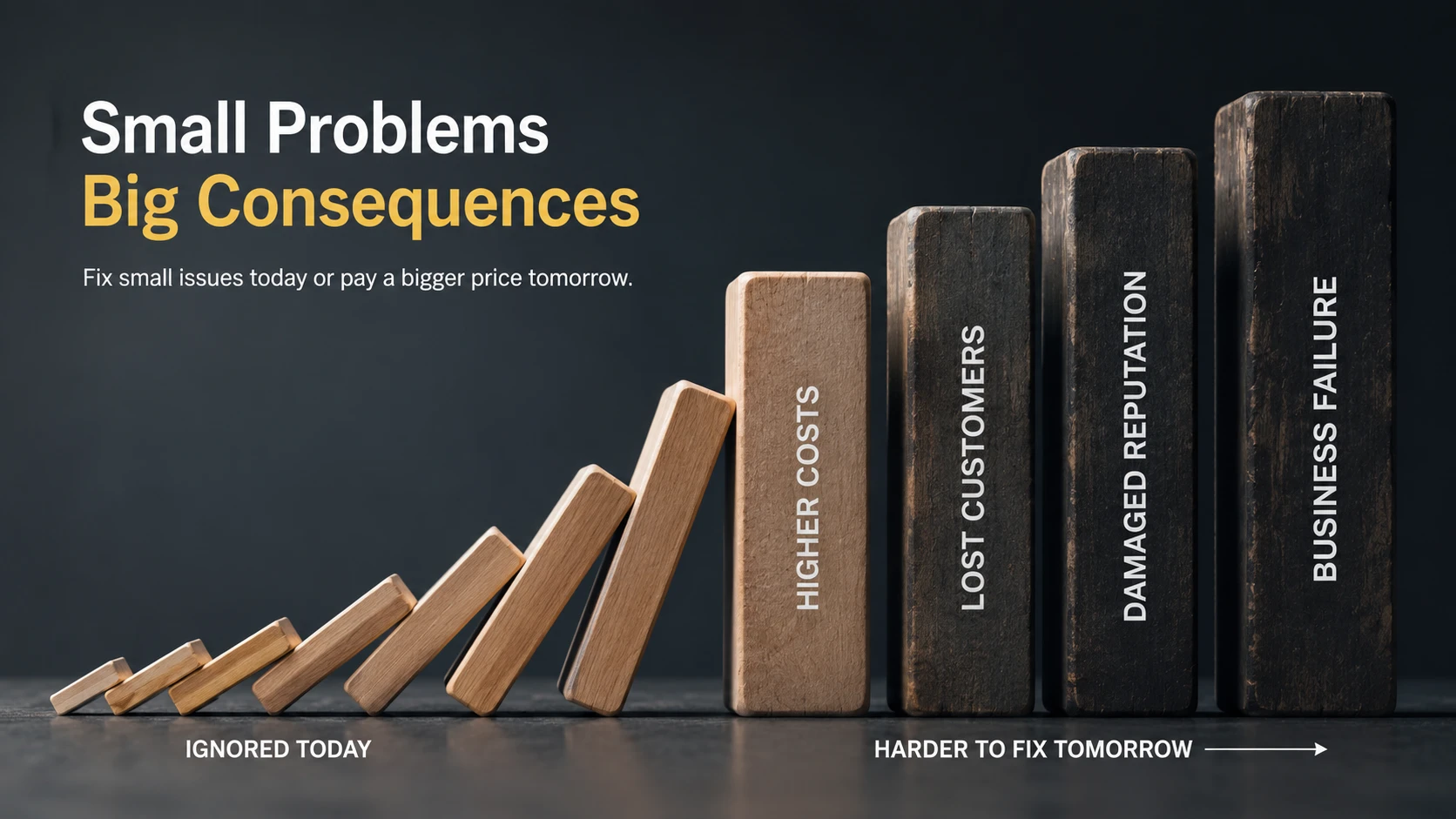
Becoming bigger usually makes those issues more expensive.
A resilient business growth strategy focuses on strengthening systems before expanding operations.
Complexity Is the Hidden Cost of Growth
Every new addition introduces complexity.
Consider a simple example.
A small manufacturing company decides to expand.
They add:
- five new employees
- three machines
- another product line
- two distributors
- new software
- another warehouse
Each decision seems reasonable.
Together, they dramatically increase complexity.
Now management has to coordinate:
- inventory
- production planning
- quality control
- supplier communication
- customer support
- logistics
- employee training
- maintenance
- reporting
Nothing looks broken individually.
But the business now has hundreds of additional interactions every day.
Complexity grows faster than revenue.
This is where fragility quietly appears.
Research from McKinsey & Company consistently shows that unnecessary organizational complexity reduces productivity and slows decision-making.
More Revenue Doesn’t Automatically Mean a Stronger Business
Many companies celebrate revenue milestones.
₹1 crore.
₹5 crore.
₹20 crore.
₹100 crore.
But revenue alone says very little about business strength.
Imagine two companies earning exactly ₹20 crore annually.
Company A
- Founder approves every decision
- Sales depend on one large customer
- Financial reporting is delayed
- No documented processes
- Employees constantly solve recurring problems
- Supplier concentration is high
Company B
- Clear systems
- Distributed decision-making
- Multiple customer segments
- Standard operating procedures
- Strong cash reserves
- Measured operational risks
Both generate identical revenue.
One business is stable.
The other is constantly one disruption away from serious trouble.
Growth should increase resilience, not just revenue.
Growth Should Reduce Dependence
One useful way to evaluate business strength is to ask:
“What happens if this disappears tomorrow?”
What if your biggest client leaves?
What if your operations manager resigns?
What if your website stops generating enquiries because a reliable digital system doesn’t support it?
What if a supplier fails?
What if you become unavailable for one month?
If the business immediately struggles, you’ve identified a dependency.
Dependencies create fragility.
Healthy businesses systematically reduce them.
Harvard Business Review has published extensively on reducing key-person dependency and building scalable organizations.
Business Growth Strategy: Remove Single Points of Failure
Every business contains bottlenecks.
Some are obvious.
Others remain invisible for years.
Common examples include:
- only one salesperson understands key accounts
- only the founder knows pricing
- one supplier provides critical materials
- customer information exists only in someone’s memory
- approvals depend on a single person
- passwords exist with only one employee
Everything appears normal—
until that person becomes unavailable.
Strong businesses identify these bottlenecks before they become crises.
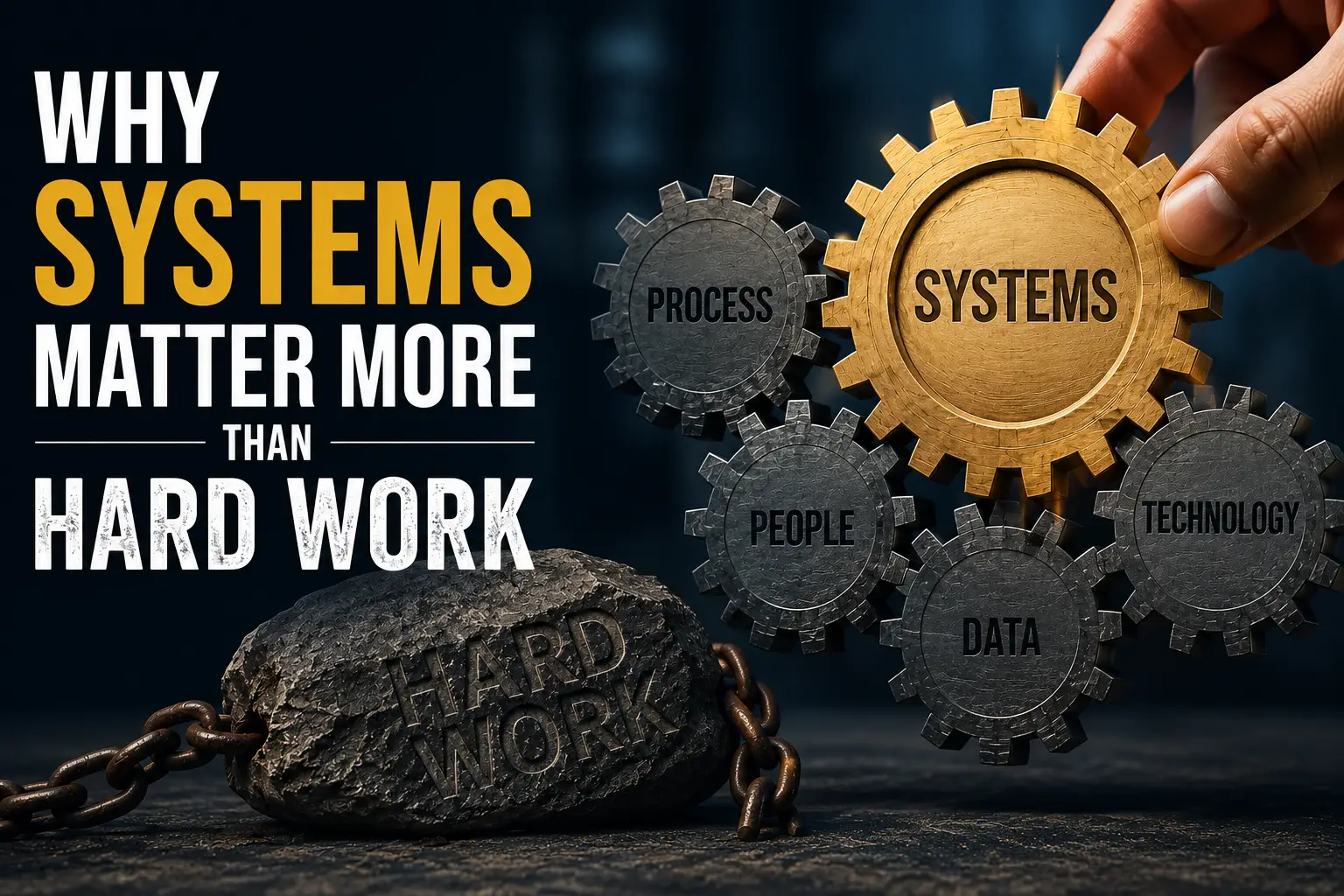
Better Systems Beat More Effort
Many owners respond to growth problems by working harder.
They stay longer at the office.
Answer more calls.
Approve more decisions.
Attend more meetings.
Eventually they become the system.
That approach doesn’t scale.
Instead of asking:
“How can I work harder?”
Ask:
“Why does this work require me at all?”
Every recurring problem deserves a permanent solution.
Effort alone rarely creates scale.
An effective business growth strategy removes unnecessary complexity instead of continuously adding more resources.
Growth Through Simplification
Many successful businesses become stronger by removing unnecessary complexity.
They simplify:
- product offerings
- approval processes
- reporting
- communication
- customer onboarding
- pricing
- internal workflows
Simplification often produces faster growth than expansion.
Because simpler systems fail less often.
A Strong Business Grows Differently
Businesses that last for decades usually focus on strengthening their foundations before chasing expansion.
They continuously ask:
- Where are we vulnerable?
- Which process breaks under pressure?
- Which decisions rely on one person?
- What assumptions are creating unnecessary risk?
- What can we simplify?
These questions may not feel exciting.
But they build durable businesses.
Practical Questions to Evaluate Your Business
Take a moment to reflect.
Can your business operate effectively without you for two weeks?
Would losing one customer significantly affect cash flow?
Does every important process have clear documentation?
Can new employees become productive quickly?
Do you regularly identify and remove operational bottlenecks?
Every “no” points toward an opportunity to strengthen your business before pursuing additional growth.
Final Thoughts
The best business growth strategy isn’t about becoming bigger as quickly as possible—it’s about becoming stronger before you scale.
Adding more people, products, customers, or technology doesn’t automatically make a business stronger.
In many cases, it simply increases complexity.
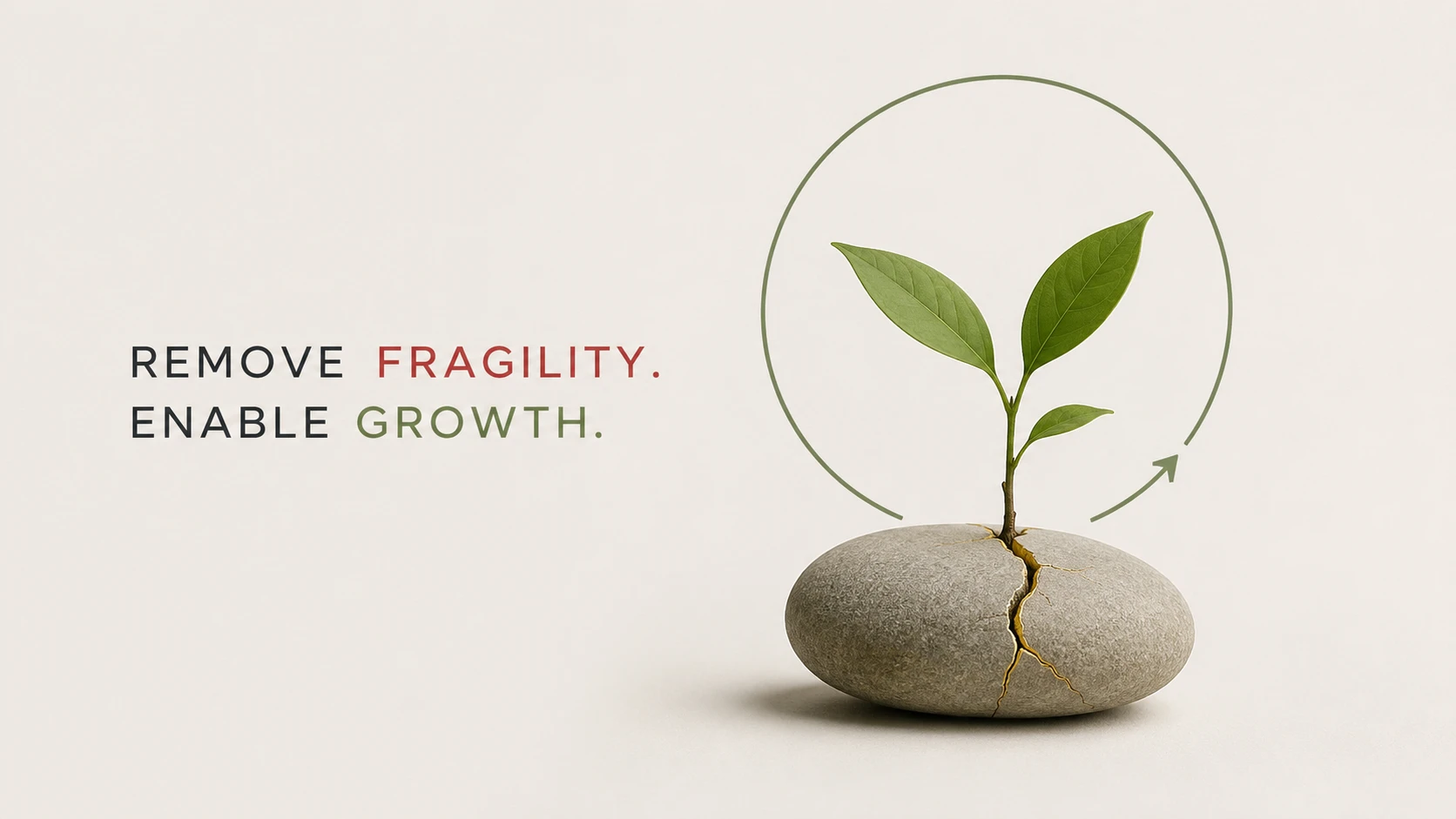
Sustainable growth comes from removing the weaknesses that limit your ability to handle greater scale.
Every improvement that reduces dependency, simplifies operations, strengthens systems, or eliminates bottlenecks makes your business more resilient.
Growth is not simply about becoming bigger.
It is about becoming stronger.
And businesses that become stronger first are the ones most likely to keep growing for years to come.
Key Takeaways
- Growth amplifies existing weaknesses.
- Complexity increases faster than most founders expect.
- Revenue is not the same as resilience.
- Remove dependencies before pursuing expansion.
- Systems scale better than individual effort.
- Simplification often creates more growth than addition.
- Strong businesses remove fragility continuously.