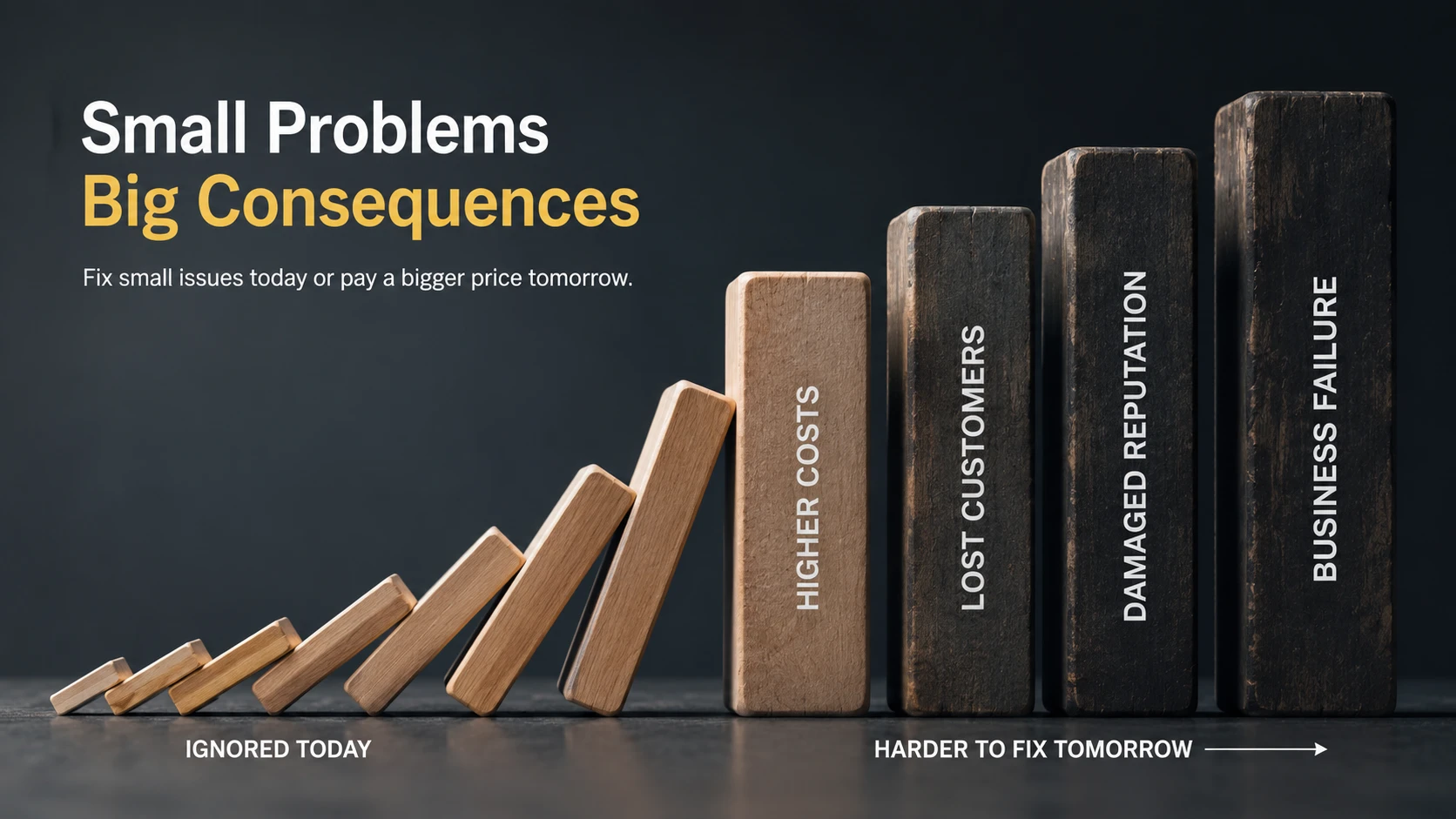

Most businesses don’t fail because of one dramatic event.
They fail because dozens of small weaknesses quietly accumulate until one unexpected problem exposes them all at once.
A delayed payment.
A key employee resigns.
A supplier stops delivering.
A cyberattack.
A major customer leaves.
Individually, none of these should destroy a healthy business.
Yet every year, businesses that appeared successful suddenly find themselves struggling because they were more fragile than they realized.
The challenge is that fragility is difficult to see while everything is working.
That’s why every business needs regular audits—not only for finances, but for resilience.
This Business Fragility Audit isn’t about compliance.
It’s about discovering hidden risks before reality discovers them for you.
This article is part of our Business Fragility series. For the complete framework, read Hidden Business Risks: Why Most Businesses Are One Weak Link Away From Failure
What Is Business Fragility?
Business fragility is the degree to which your company depends on conditions remaining perfect.
The more your business depends on:
- One customer
- One employee
- One supplier
- One founder
- One revenue source
- One technology
- One assumption
…the more fragile it becomes.
Strong businesses don’t eliminate every risk.
They reduce unnecessary dependence.
Why Every Founder Should Perform This Audit
Founders often measure:
- Revenue
- Profit
- Growth
- Sales
- Marketing performance
Few measure resilience.
That creates a dangerous blind spot.
A company can appear healthy while becoming increasingly vulnerable underneath.
Regular fragility audits help founders answer one important question:
“If something unexpected happened tomorrow, how well would my business respond?”
How to Use This Audit
For every question, answer honestly.
Score yourself:
- Yes = 2 points
- Partially = 1 point
- No = 0 points
Don’t overthink.
The goal isn’t perfection.
The goal is awareness.
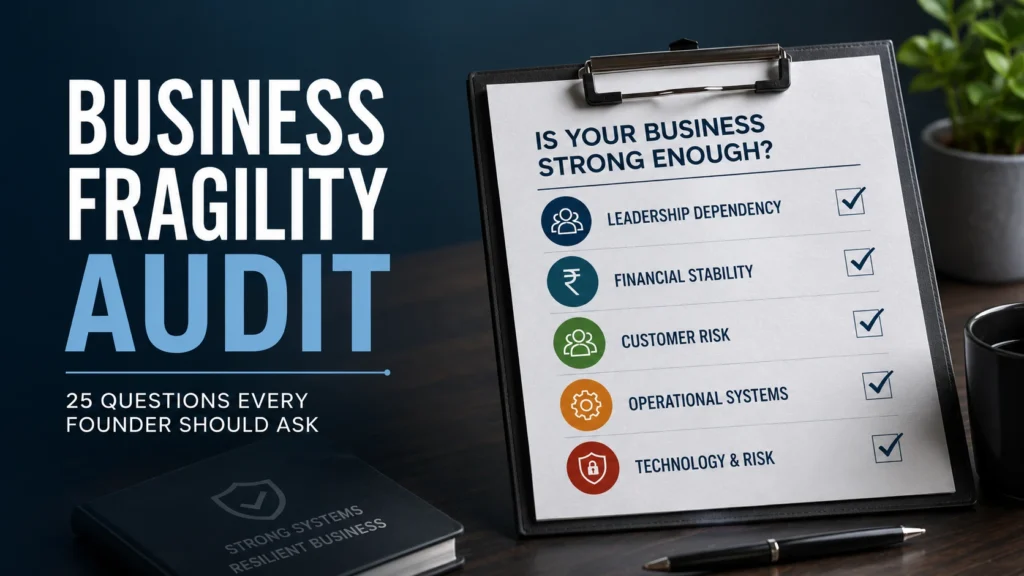
Section 1: Leadership Dependency
1. Can the business operate for two weeks without your daily involvement?
2. Are your key processes documented?
3. Can another team member perform your critical responsibilities?
4. Are important business decisions based on systems rather than memory?
5. Do employees know what to do without constantly asking the founder?
Section 2: Financial Stability
6. Could your business survive three months with reduced revenue?
7. Do you regularly monitor cash flow?
8. Is no single customer responsible for a dangerous percentage of revenue?
9. Do you have an emergency cash reserve?
10. Are profits consistently reinvested into strengthening the business?
Section 3: Customer Risk
11. Are new customers generated consistently?
12. Do you understand why customers choose your business?
13. Do you collect customer feedback regularly?
14. Are customer relationships spread across multiple industries or segments?
15. Would losing your biggest customer be manageable?
Section 4: Operational Systems
16. Are critical business processes documented?
17. Can operations continue if one employee resigns?
18. Are responsibilities clearly defined?
19. Are recurring tasks automated wherever practical?
20. Is business performance measured using key metrics?
Section 5: Technology & Risk
21. Are business data and systems backed up regularly?
22. Do you have cybersecurity measures in place?
23. Are software licenses, domains, and hosting properly managed?
24. Is there a recovery plan if technology fails?
25. Do you review business risks at least once every quarter?
Scoring Your Business
41–50 Points
Strong Foundation
Your business appears resilient.
Continue reviewing systems regularly because resilience is never permanent.
26–40 Points
Moderate Risk
Your business is functioning well but has several hidden dependencies.
Now is the ideal time to strengthen weak areas before they become expensive.
0–25 Points
High Fragility
Every improvement you make now will reduce future risk.
Your business depends heavily on people, assumptions, or circumstances remaining unchanged.
Don’t wait for a crisis to expose these weaknesses.
Common Patterns Found During Fragility Audits
After working with many growing businesses, similar patterns appear repeatedly.
Founder Dependency
Everything requires the founder.
Nothing moves without them.
Growth eventually slows because the business cannot scale beyond one person’s capacity.
Customer Concentration
A few customers generate most revenue.
Losing one client creates immediate financial pressure.
Knowledge Locked Inside People
Critical knowledge exists only inside employees’ heads.
When people leave, knowledge leaves with them.
Lack of Process Documentation
Tasks are repeated differently every time.
Quality becomes inconsistent.
Mistakes become expensive.
No Emergency Planning
Businesses prepare for growth.
Few prepare for disruption.
What Makes Businesses More Resilient?
Resilient businesses intentionally reduce dependency.
They build:
- Documented systems
- Financial reserves
- Multiple customer channels
- Process automation
- Cross-trained teams
- Risk reviews
- Operational visibility
- Continuous improvement
None of these guarantee success.
But together, they dramatically improve your ability to handle uncertainty.
Fragility Never Disappears
Every stage of growth introduces new risks.
A startup has different vulnerabilities than a mature company.
As your business evolves, your fragility changes too.
That’s why this audit shouldn’t be completed once.
It should become part of your management rhythm.
Quarterly reviews often reveal problems while they’re still small enough to fix.
Final Thoughts
Most founders spend their time asking:
“How do we grow faster?”
A better question is:
“What could stop us from growing?”
Growth creates opportunity.
Reducing fragility protects it.
The strongest businesses aren’t those that avoid every problem.
They’re the ones prepared for problems before they arrive.
Key Takeaways
- Business fragility is often invisible until a disruption occurs.
- Hidden dependencies create unnecessary risk.
- Regular fragility audits reveal weaknesses before they become crises.
- Strong systems reduce reliance on individuals and assumptions.
- Business resilience is built through continuous improvement, not one-time fixes.
Want to understand how resilient your business really is?
Start by answering these 25 questions honestly. The gaps you uncover today could prevent the problems that threaten your business tomorrow.
Every stronger business begins with better questions.