
Every business owner has experienced it.
A customer complains about something that seems insignificant.
An employee points out a process that could be improved.
A supplier misses a delivery once.
A website becomes slightly slower.
A report contains inconsistent numbers.
None of these feels urgent.
So they get postponed.
After all, there are bigger priorities.
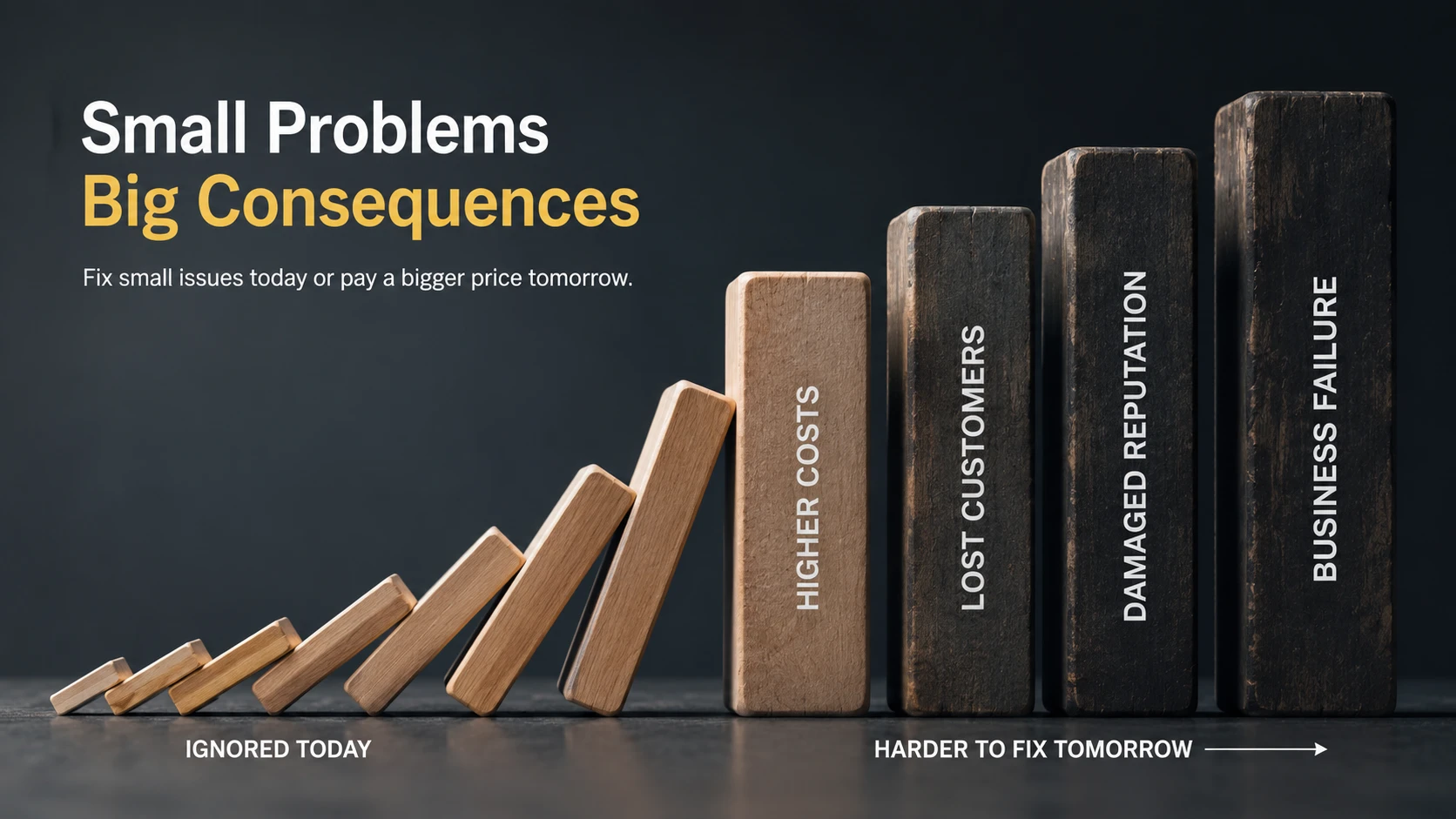
But months later, those same “small problems” often become the reason businesses lose customers, waste money, damage their reputation, or struggle to grow.
The biggest business crises rarely begin as big events.
They usually begin as small problems that nobody thought were worth fixing.
This article is part of our Business Fragility series. For the complete framework, read Hidden Business Risks: Why Most Businesses Are One Weak Link Away From Failure
Small Problems Compound Over Time
Business owners naturally focus on visible opportunities.
More sales.
More customers.
More products.
More marketing.
Yet growth often hides weaknesses instead of solving them.
Imagine a tiny crack in a building’s foundation.
The crack doesn’t collapse the building today.
Or tomorrow.
But every season, water enters.
Pressure increases.
Materials weaken.
Eventually, the structure becomes unstable—not because of one catastrophic event, but because one small issue was ignored for too long.
Businesses work exactly the same way.
Operational weaknesses grow quietly.
Poor habits become standard practice.
Manual work becomes accepted.
Temporary fixes become permanent systems.
By the time the problem becomes obvious, fixing it is far more expensive than preventing it.
The Hidden Cost of Delayed Decisions
Ignoring problems feels inexpensive.
Businesses often believe they’re stable until one weakness becomes a crisis. That’s why every business should identify its critical thread before it breaks.
In reality, it creates hidden costs.
These costs rarely appear in financial statements immediately, but they slowly reduce the business’s performance.
Some common examples include:
- Lost productivity
- Employee frustration
- Customer dissatisfaction
- Increasing operational costs
- More frequent mistakes
- Slower decision-making
- Missed business opportunities
- Lower profit margins
Each issue may seem minor individually.
Together, they quietly reduce the company’s ability to compete.
Organizations that follow ISO 31000 risk management principles regularly assess emerging risks before they become major operational problems.
Why Business Owners Ignore Small Problems
Most founders are not careless.
They’re simply busy.
Several psychological factors make small problems easy to postpone.
1. The Problem Doesn’t Hurt Yet
If revenue is still coming in, everything appears fine.
The absence of immediate pain creates a false sense of security.
Unfortunately, risk grows long before consequences become visible.
2. Immediate Work Feels More Important
Today’s client deadline always feels more urgent than improving an internal process.
As a result, businesses stay trapped in reactive work.
Improvement keeps getting postponed.
3. Small Problems Become Normal
Humans adapt quickly.
After repeating inefficient work every day, teams stop questioning it.
“We’ve always done it this way.”
That sentence often signals hidden operational risk.
4. Optimism Bias
Business owners naturally believe things will improve on their own.
Sometimes they do.
Most of the time, they don’t.
Unresolved issues usually become larger and more expensive.
Real Business Examples
Customer Service
One customer complains about delayed responses.
The business ignores it.
Soon multiple customers experience the same issue.
Online reviews decline.
Customer retention falls.
Acquiring new customers becomes harder.
Finance
Invoices are occasionally delayed.
Nobody follows a consistent payment process.
Months later, cash flow becomes unpredictable.
The company struggles to pay suppliers despite having profitable projects.
Operations
One spreadsheet becomes difficult to manage.
Instead of improving the system, new spreadsheets are created.
Eventually nobody knows which data is accurate.
Decision-making slows dramatically.
Sales
Lead information is stored inconsistently.
Different salespeople maintain separate records.
Follow-ups are missed.
Potential customers choose competitors—not because of price, but because of poor coordination.
Website
A website loads a little slower every month.
Broken forms remain unnoticed.
Content becomes outdated.
Search rankings gradually decline.
Lead generation decreases without anyone realizing why.
Small Problems Multiply Each Other
Business issues rarely exist alone.
One weakness creates another.
For example:
Poor documentation leads to employee dependency.
Employee dependency creates operational risk.
Operational risk increases customer delays.
Customer delays reduce satisfaction.
Lower satisfaction reduces referrals.
Fewer referrals increase marketing costs.
Everything becomes connected.
This is why systems thinking matters.
Instead of fixing isolated problems, businesses must understand how problems interact.
Prevention Is Always Cheaper Than Recovery
Fixing a small issue early usually requires:
- Less time
- Less money
- Fewer people
- Minimal disruption
Fixing the same issue after it grows often requires:
- Emergency decisions
- Significant investment
- Customer recovery efforts
- Staff overtime
- Reputation rebuilding
Prevention almost always costs less than recovery.
Build a Business That Detects Problems Early
Strong businesses don’t wait for crises.
They build systems that reveal problems while they’re still manageable.
Examples include:
- Weekly operational reviews
- Customer feedback tracking
- Financial dashboards
- Process documentation
- Website performance monitoring
- Regular risk assessments
- Supplier performance reviews
- Internal audits
These practices don’t eliminate every problem.
They simply ensure problems are discovered before they become expensive.
Questions Every Business Owner Should Ask
Take a few minutes and reflect on your business.
Ask yourself:
- Which recurring issue have we accepted as “normal”?
- What task repeatedly wastes time every week?
- Where do customers experience unnecessary friction?
- Which process depends entirely on one person?
- What problem have we postponed for more than six months?
- If we ignored this issue for another year, what would happen?
- Which small weakness could create the biggest financial impact?
Your answers may reveal risks hiding in plain sight.
The Bigger Lesson
Business failure rarely arrives overnight.
It grows gradually through hundreds of ignored decisions.
Every unresolved issue sends a signal.
Every shortcut creates future work.
Every delayed improvement increases future costs.
The strongest businesses aren’t those that avoid problems.
They’re the ones that identify, prioritize, and solve small problems before they become major ones.
Growth isn’t just about doing more.
It’s about removing obstacles before they limit your future.
Final Thoughts
Every business has small problems.
That isn’t the real risk.
The real risk is believing they can safely wait.
Successful businesses create a habit of solving problems while they’re still inexpensive, manageable, and easy to fix.
Because in business, time doesn’t make problems disappear.
It usually makes them bigger.
Key Takeaways
- Small problems rarely remain small.
- Delayed decisions increase both cost and complexity.
- Minor operational issues compound into larger business risks.
- Prevention is significantly less expensive than recovery.
- Regular reviews and strong systems help identify issues early.
- Sustainable growth comes from reducing weaknesses, not just increasing revenue.