
Most Businesses Don’t Stop Growing Because of Competition
Many business owners believe growth stops because of:
- Lack of customers
- Price competition
- Market slowdown
- Economic conditions
- New competitors
While these factors can affect any business, they are rarely the real reason growth stalls.
In many cases, the biggest obstacle is hidden inside the business itself.
It is a weak link that quietly limits growth, increases stress, and creates problems long before owners recognize it.
The challenge is that this weak link often remains invisible until the business reaches a breaking point.
This article is part of our Business Fragility series. For the complete framework, read Hidden Business Risks: Why Most Businesses Are One Weak Link Away From Failure
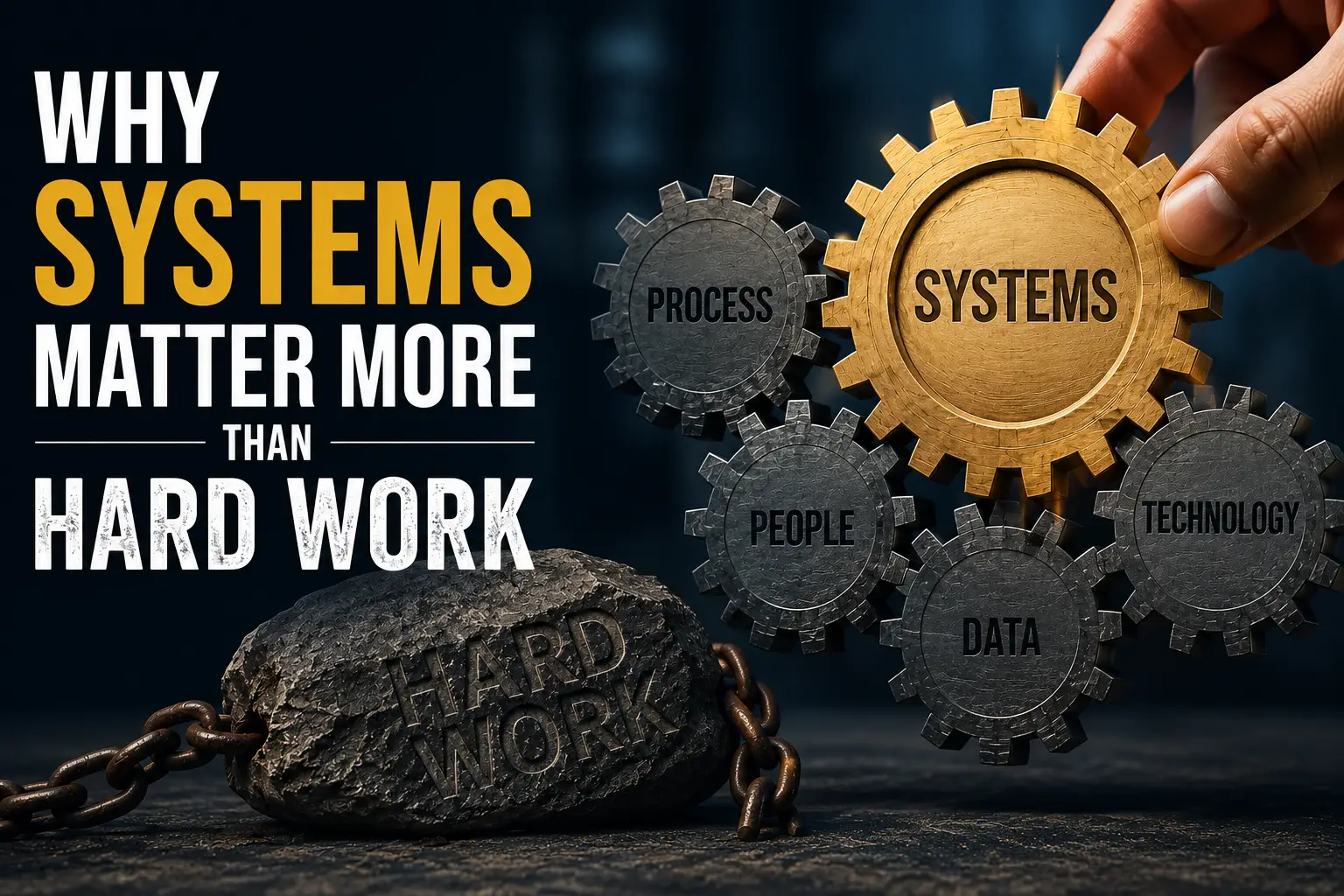
Every Business Is a System
A business is not just a collection of people, products, and customers.
It is a system.
Like any system, its overall performance depends on how well all its parts work together.
Think of a bicycle.
A stronger frame, better brakes, and premium tyres cannot compensate for a broken chain.
The bicycle still won’t move.
Businesses work the same way.
Adding more marketing, hiring more employees, or buying new software cannot solve problems if one critical part of the business is holding everything back.
Growth is limited by the weakest part of the system.
The Weak Link Is Often Hidden
One reason businesses struggle is that owners naturally focus on visible problems.
For example:
- Sales are low, so they increase advertising.
- Customer complaints rise, so they hire more support staff.
- Projects are delayed, so they recruit more employees.
These solutions address symptoms.
They do not address the underlying cause.
The actual weak link usually sits deeper inside the business.

Common Hidden Weak Links
Every business is different, but certain weak links appear repeatedly across industries.
1. The Owner Is the Bottleneck
This is perhaps the most common growth constraint.
Every important decision flows through one person.
The owner approves quotations.
The owner solves customer issues.
The owner manages employees.
The owner reviews payments.
The owner checks quality.
The owner handles hiring.
Everything waits for one individual.
Initially this feels like control.
Eventually it becomes the biggest obstacle to growth.
When the owner becomes the system, the business cannot grow beyond the owner’s capacity.
2. No Standard Processes
Many businesses rely on experience instead of documented processes.
Employees learn by watching others.
Everyone performs the same task differently.
Quality varies.
Mistakes repeat.
New employees take months to become productive.
Without standard systems, growth creates confusion instead of efficiency.
3. Poor Information Flow
Important information lives inside people’s heads.
Customer conversations are forgotten.
Sales commitments never reach production.
Purchase updates never reach accounts.
Different departments work with different information.
Small communication gaps become expensive business problems.
4. Decisions Based on Assumptions
Many owners make decisions based on intuition alone.
Sometimes intuition works.
Often it doesn’t.
Without reliable data, businesses may:
- Stock the wrong inventory.
- Hire too early.
- Expand too fast.
- Cut the wrong expenses.
- Chase unprofitable customers.
Better decisions require better information.
5. Technology Without Process
Many businesses purchase software expecting it to solve operational problems.
But software only accelerates existing processes.
If the process itself is inefficient, technology simply helps the business make mistakes faster.
Automation cannot replace clarity.
Why Weak Links Stay Hidden
The biggest challenge is that weak links rarely announce themselves.
Instead, they create indirect symptoms.
You may notice:
- Employees constantly asking questions.
- Customers following up repeatedly.
- Projects taking longer every month.
- Increasing overtime.
- Growing frustration inside the team.
- Cash flow becoming unpredictable.
- The owner feeling busier despite higher revenue.
These symptoms appear unrelated.
In reality, many originate from the same underlying weakness.
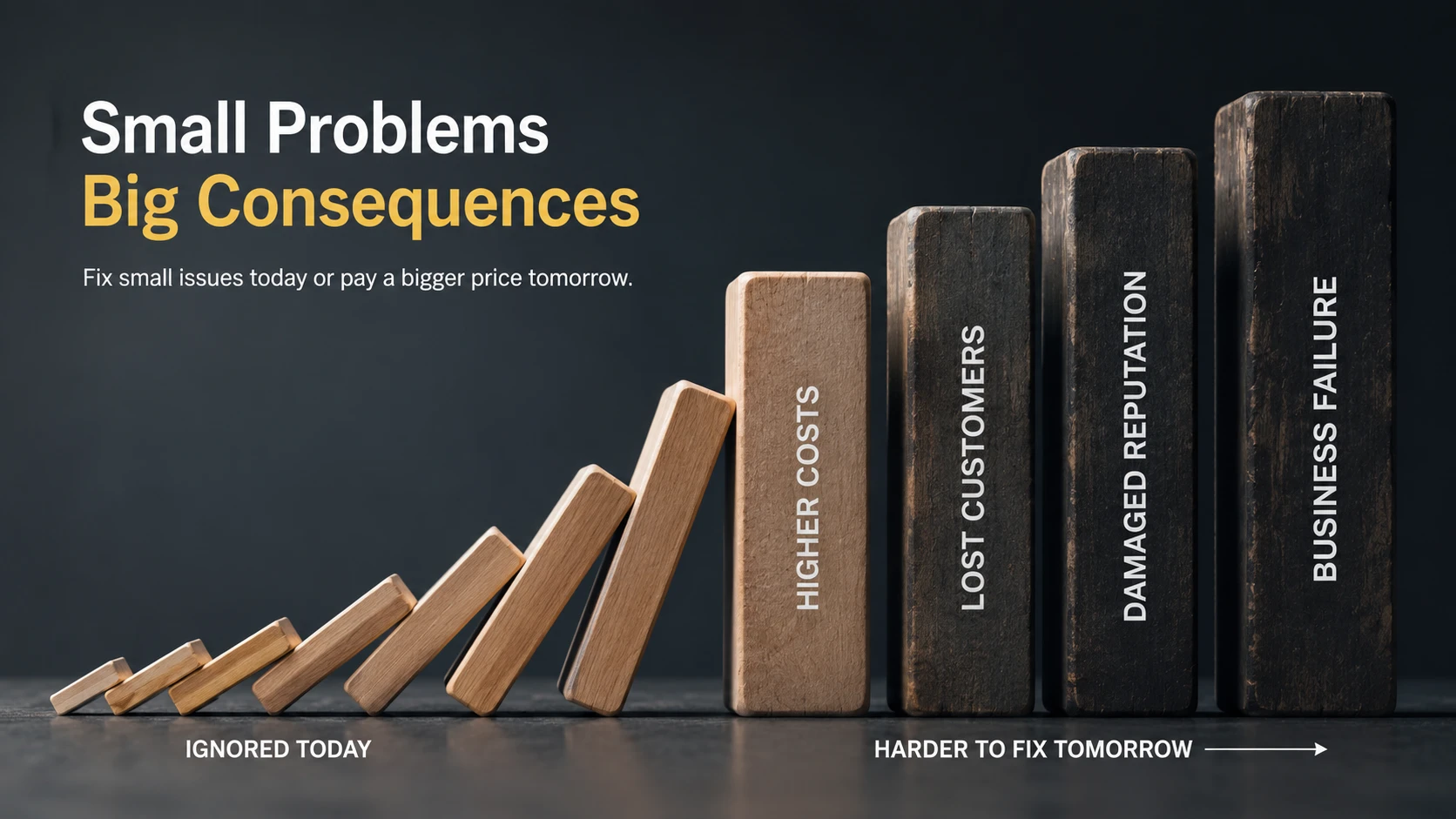
Growth Magnifies Weaknesses
Many business owners believe problems disappear as revenue increases.
The opposite is usually true.
Growth acts like a magnifying glass.
A small operational weakness that causes occasional delays at ₹50 lakh revenue can create major disruptions at ₹5 crore.
More customers.
More employees.
More orders.
More complexity.
Every hidden weakness becomes more visible.
Businesses rarely outgrow poor systems.
They usually grow into bigger versions of the same problems.
A Simple Example
Imagine a manufacturing company generating steady enquiries.
To increase sales, they invest heavily in digital marketing.
Enquiries double.
At first, everyone celebrates.
Within weeks:
- Sales executives forget to follow up with prospects.
- Quotations are delayed.
- Customer requirements are misunderstood.
- Production receives incomplete information.
- Delivery schedules slip.
- Existing customers become unhappy.
The problem wasn’t marketing.
Marketing exposed the real weak link: an inefficient sales and operational system.
More leads simply placed greater pressure on an already fragile process.
How to Find Your Weak Link
Instead of asking:
“How can we grow faster?”
Ask:
“What is preventing us from handling twice the business we have today?”
Look carefully for recurring friction.
Questions worth asking include:
- Which activity depends entirely on one person?
- Where do projects usually slow down?
- Which mistakes keep repeating?
- What causes the most customer complaints?
- Which process feels chaotic every week?
- Where does information frequently get lost?
- If one employee left tomorrow, which function would struggle the most?
The answers often reveal the real constraint.
Fix the System Before Scaling
Many businesses attempt to scale before strengthening their foundation.
This increases complexity without improving capability.
Instead:
- Simplify workflows.
- Standardize processes.
- Document critical activities.
- Remove unnecessary approvals.
- Improve visibility across departments.
- Reduce dependency on individuals.
- Measure important business metrics consistently.
Once the weak link is strengthened, the entire business becomes more resilient.
The Goal Isn’t Perfection
Every business has constraints.
That is normal.
The objective is not to eliminate every weakness.
It is to identify the one constraint that is limiting growth today and improve it.
Once that constraint is resolved, another one will emerge.
Business improvement is an ongoing process of identifying, strengthening, and refining the system.
Final Thoughts
Most businesses don’t stop growing because they lack ambition.
They stop growing because one hidden weakness quietly limits the performance of the entire system.
The businesses that achieve sustainable growth are not necessarily those with the biggest budgets or the most employees.
They are the ones that consistently identify their weakest link before it becomes a major problem.
Growth isn’t just about adding more.
Sometimes, it begins by strengthening what already exists.
Key Takeaway
Every business has a weak link. The businesses that grow consistently are the ones that identify it early, strengthen it systematically, and build systems that no longer depend on a single person, process, or assumption.
Is your business ready to handle double the customers it has today, or would one hidden weakness bring everything to a halt?
If you’re unsure, start by mapping your key business processes and identifying where work consistently slows down. Finding that one weak link may unlock more growth than your next marketing campaign.